

|
|
WetlandInfo—your first-stop-shop for wetland management resources in QueenslandSelect the area type
WetlandSummary—facts and mapsFind wetland information for regions of Queensland. WetlandSummary provides:
⚠
Do not touch sick or dead wild birds or wildlife. If you suspect bird flu in any species of animal, you must report it immediately to the Emergency Animal Disease Hotline on 1800 675 888. Read more information about Avian influenza. WetlandUpdate September 2026Read the full newsletter (with pages links) or subscribe. New pages and toolsUpdated pages and toolsACA for Fitzroy GBR Connecting Catchments
Updated Gulf mangrove dieback and recovery application
Updated Climate Change pages
WetlandMaps and WetlandSummary
Programs, policy and legislation
New and updated documentsACA for Fitzroy GBR Connecting Catchments Information Sheet
ACA for Fitzroy GBR Connecting Catchments Summary Report
ACA for Fitzroy GBR Connecting Catchments Expert Panel Report
Mangrove trajectory to recovery post dieback in the Gulf of Carpentaria, Queensland
Additional links
We value your input and feedback so please email us your comments, wetland information and links or that wetland question you just can't answer. Wonderful wetlands
Wetlands are important for our environment, economy and our livelihoods. They have many functions from reducing floods to producing clean water and food for humans, industry and agriculture. They provide important habitat for many animals and plants. Wetlands are the great ‘connectors’ across our landscape providing places for our enjoyment and relaxation. Regardless of whether you are doing a school or uni assignment, managing a wetland or undertaking research, you will find a wealth of information here on WetlandInfo. Read more… WetlandInfo feature species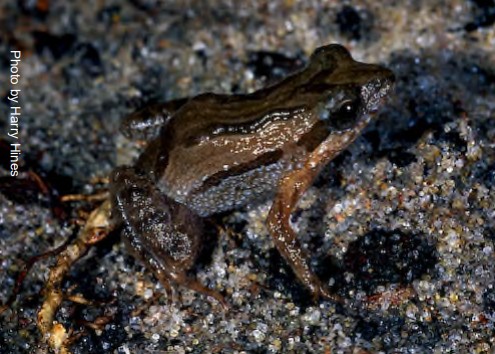
Crinia tinnula, Wallum froglet. Photo by Harry Hines
The feature species for September 2026 is Crinia tinnula, the wallum froglet. The wallum froglet (Crinia tinnula) is a small (up to approx. 20mm) species of frog found in the coastal habitats of Queensland and New South Wales, ranging from as far north as Bundaberg, down to the very south-east corner of the State. These frogs are highly specialised, requiring acidic (pH <6.0, sometimes low as 4.3), freshwater wetlands, such as Melaleuca swamps, sedgeland, wet or dry heathland and wallum/woodland. Unlike many other species, the wallum froglet may breed throughout any season of the year, waiting for suitable weather conditions instead of a particular period on the calendar. Therefore, it is one of the few frogs that can be heard during winter. Due to its small size, C. tinnula can be very difficult to find, even when calling nearby. Identification is best achieved by its unique call. If spotted, it is possible to identify it by a thin, pale belly line, despite its highly variable colours and patterns and similarity to other local Crinia species. The back may be a variety of browns, greys, beiges or even red, and the underside, while typically white, can have dark patterns such as spotting or patches. This froglet also has no webbing present on its feet, and lacks padding or discs on its toes. Additional information |


Site footer


 — Department of the Environment, Tourism, Science and Innovation