

|
|
WetlandInfo—your first-stop-shop for wetland management resources in QueenslandSelect the area type
WetlandSummary—facts and mapsFind wetland information for regions of Queensland. WetlandSummary provides:
WetlandUpdate February 2026 World Wetlands Day is celebrated on 2 February each year. It marks the anniversary of the signing of the Convention on Wetlands of International Importance in the Iranian city of Ramsar in 1971. The convention now has a global membership of over 170 countries and the day represents a global awareness campaign to highlight the value of wetlands. Find more information on World Wetlands Day in Queensland here. Read the full newsletter (with pages links) or subscribe. Our domain has changedWetlandInfo now has a new domain - please update any bookmarks or links to our pages. Please update to https://wetlandinfo.detsi.qld.gov.au/ New pagesUpdated pages and tools
New and updated documentsAdditional links
We value your input and feedback so please email us your comments, wetland information and links or that wetland question you just can't answer. Wonderful wetlands
Wetlands are important for our environment, economy and our livelihoods. They have many functions from reducing floods to producing clean water and food for humans, industry and agriculture. They provide important habitat for many animals and plants. Wetlands are the great ‘connectors’ across our landscape providing places for our enjoyment and relaxation. Regardless of whether you are doing a school or uni assignment, managing a wetland or undertaking research, you will find a wealth of information here on WetlandInfo. Read more… WetlandInfo feature species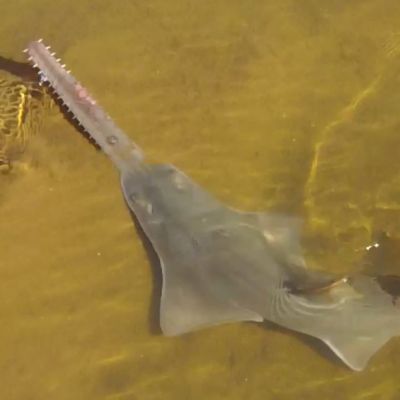
Pristis pristis, the Freshwater Sawfish. Photo by Sharks and Rays Australia
The feature species for February 2026 is the Pristis pristis, the freshwater sawfish (other common names include freshwater (largetooth) sawfish). The freshwater sawfish is the largest freshwater fish in Australia, in the family Pristidae. The freshwater sawfish is found worldwide in tropical and subtropical coastal regions, but also enters freshwater. A critically endangered species, it is an easily recognised species by the extension of their upper jawbone, the rostrum that resembles a saw with serrated edges. The freshwater sawfish feeds on fish, molluscs and crustaceans. The 'saw' can be used to both stir up the bottom of a waterbody to find prey and to slash at groups of fish. Some First Nations communities in Northern Australia have strong cultural connections to sawfishes and in some communities, sawfish are a source of food. Overfishing and habitat change are impacting sawfish populations, with a dependancy on freshwater and estuarine water quality and availability. The sawfish will spend its first 3-4 years in estauries and rivers, growing to half its adult size (3m). After this, they move to coastal and offshore waters up to 25m deep. Freshwater sawfish embryos grow attached to the eggs inside the mother and are born alive at around 76cm in length, with their saws covered in a sheath to protect the mother. They grow up to 6.5m, with a flattened shape, two prominent dorsal fins, eyes positioned on top of their head with gills beneath their body. Their skin resembles that of sharks, which is sandpaper-like. Additional information |


Site footer


 — Department of the Environment, Tourism, Science and Innovation